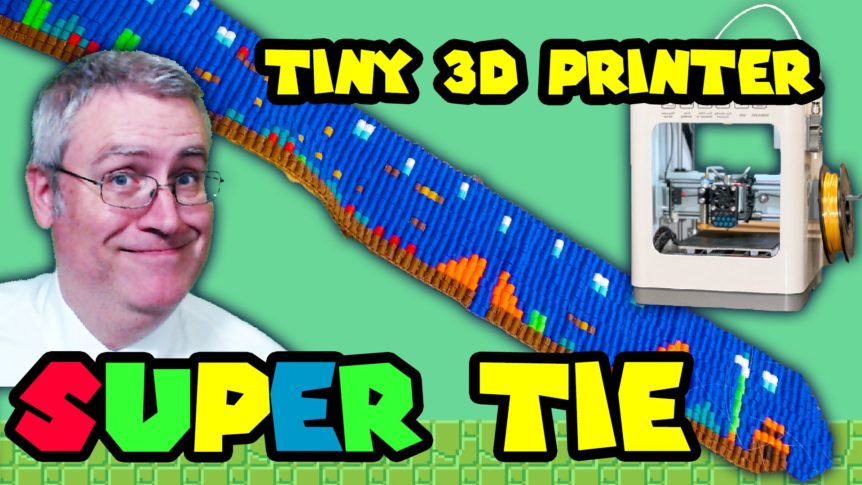
I’ve been sitting on the Weefun Tina 2, the tie project I did with it, and this video for a very long time. The reason is because of their app. And at this time their app is still stealing models without attribution. And even if that weren’t the case, it doesn’t add supports on items that need it. But Weefun knows this, they’ve acknowledged it, and they’ve indicated they’re working on some new features and will roll those into a future update. We’ll see if they ever do that.
In the past this would have been cause for me never releasing the video. But that tie is just too SWEET not to tell the story!
Plus, I’ve got an even better printer to tell you about next time.
But my all-or-nothing stance on attribution has loosened somewhat. And while I wish I could say that it was because I’ve grown as a person, the truth is I’m probably just tired of the fight. It seems like no sooner do we, as a community, find and take out one of these copyright violations that another one pops up.
But I’ve also come to a realization that, at least when it comes to ownership of intangibles, that we in the west may be the weird ones. I’ve been working on how to present this idea for a while now, and I may make a dry run of it here.
I want to start by pointing out that none of my comments should be taken to be apologists or excusatory. If I’m giving off that impression, hope you’ll stick with me to the end. The goal of this discussion is understanding. Because you can’t hope to change a mind if you don’t understand it first.
Whenever I mention any company with ties to China, there’s a portion of my audience that delights in brining up China’s lax enforcement of copyrights and how they’ve tread on the toes of makers in this community, many times. And that’s very true. But these accusations stem from an assumption that there’s malicious intent. I don’t think that’s the case.
My comments don’t come from a place of any particular academic expertise. I’m not a professor of Asian cultural studies. I have lived in Asia for a few years in my youth and have a vested interest in the subject as a content creator. But there are aspects of this discussion that I still don’t completely understand myself, and most of my evidence is anecdotal at best.
I have observed that for people raised in South East Asia. in general, a creators right to control how their creations are used by others is not something they have any respect for. For them, once it’s in their hands, they have the right to do whatever they want with it, whatever it is. I remember a time in Malaysia when I was buying some software for my PC and the store owner, without a sideways glance or hint of clandestine dealing, asked “do you want the bootlegs?”, and he pulled out a box of CR-RWs with cracked copy protection and inkjet printed inserts. No shame. No hiding. And while in the western world this would be seen as, at the very least taboo, to him it was just another buying option that he was providing for his customer.
This may seem unrelate, but did you know in Asia it’s easier to sell insurance and that people, in general, save more there? The reason why, some experts think, is because many Asian languages do not conjugate for time. I, myself, noticed this as I gained familiarity with the quirks of “Singlish”, the pigeon English spoken by people in Singapore that’s a mix of English vocabulary with Chinese and Malay grammar structures. They would say everything as if it were happening right now, and then append “next time” or “last time” to clarify. So they’d say “I am reading this next time”, meaning “I will read this”. Or they’d say “I am reading this last time” which means “I read this”. This linguistical immediacy, some say, is the reason why they view the future, the past, and the present as one and why it’s easier to convince them to save for or insure against the future than those of is in western socity.
I mention this because it’s an example how a little thing, like how we speak, can effect a whole people’s mentality. I don’t know if there is a similar root cause to their lackadaisical attitudes towards intellectual property, but it wouldn’t surprise me. However, as I think about it, I wonder if maybe it’s not that they have something against it. Maybe there’s something about us that makes us more willing to accept the idea that a person can still have the right to control something after it’s left their hands
Because if you think about it, copyright is not a natural idea. It doesn’t apply to objects. If you buy something, you expect to have the right to do whatever you want with it. The making community is fighting another0 battle, right now, to insure that buyers can maintain their right to repair the things they bought. This is because companies like Apple are trying to make it so if your iDevice breaks you have to come to them for a fix. We understand the idea that once you buy something it should be yours. Want to sell that old car? You don’t have to go back to the dealer to get it unlocked so you can sell it to someone else. You bought it, it’s yours to do with as you wish.
But, if that thing is “an original work fixed in a sufficiently permanent medium such that the work can be perceived, reproduced, or communicated for more than a short time” (US Copyright law), suddenly we’re up in arms about someone who wants to make copies of the thing they bought with their money and sell it to other people. And, to me, it seems that we inherently get that it’s the reproducibility that’s the defining factor. You sell a car, you don’t have a backup of the car that you can still drive around. A thing has passed from one hand to another. But if it can be copied, we hold sacred the right to control who can and can’t make those copies.
Hopefully you can see how unnatural that idea is, though. Copyright is protected by law. It required us spelling out in writing and teaching our children how it works. We teach it in 100 different ways over their lifetime. But it’s didn’t come naturally. It may seem natural, now that we’re so used to it, but the idea is, admittedly, pretty artificial.
Now, I want to be clear. I absolutely believe that a world where creatives are safe to share their work without fear of it being reproduced by someone else without compensation, is a better world that one that doesn’t. I hear quite often that “once it’s out there, it’s fair game.” But if this was the norm it would be chaos. Imagine a major movie theaters who wouldn’t let you see their latest blockbuster without draconian measures to insure you weren’t going to film it and copy it. Like if you went to the movies (a stretch for some these days) they made you turn in your phone at the door, and then would have the ushers policed the audience during the show, and if they caught someone trying to make a bootleg they’d disrupt the film to stop them, all because if that person got a copy of the film they could sell bootleg copies on the street without consequence. Or consider the case of sixteenth-century mathematicians who held in secret the formulas they found that enabled them, and only them, to solve certain hard problems, because it wasn’t safe for them to share them with the world or they might lose their government positions in a mathematical dual. Generations of human advancement were stymied by the fact that they couldn’t share their knowledge. Copyright and Intellectual Property protections is absolutely a cornerstone of a functional, advanced society. I do not want to live in a world where works and ideas can’t flow freely.
(Okay. At this point I have to choose my words carefully. Because I want to avoid saying something like “we’re better than them”, but in light of what I just said, I’m walking a thin line here. Here goes.)
However, I again want to emphasize that while I am of the position that Intellectual Property protections are good, they are not natural. If you haven’t been taught your whole life to respect them, they are as foreign as though they had come from the moon. And most of us who do respect them couldn’t enumerate why. Which leads to a problem. If you say to someone who regularly infringes on copyright, “you can’t do that”, they think “Well, clearly I can, because I am.” And when you say “you’re violating copyright” they don’t have any context for what you’re talking about. And if your reason, as mine has been in the past, is “it’s a law and you need to keep it”, they treat it the way the speed limit is treated the loneliest highway at 3 in the morning. Sure it’s a law, but no one cares.
We need to recognize that getting China to respect copyright is nothing short of trying to change the mind of a whole nation. Heck, a whole continent, really.
Which is why the last time I talked about this in my “3D Printing needs to get better” video, I tried to approach it from the benefits to them of keeping creators happy. I tried to point out that if creators feel safe giving you access to their stuff, they will literally fill up your coffers for you.
Right now, CreailtyCloud is running 2 different versions. Their primarily English CrealityCloud.com respects creators and doesn’t allow reposts of other people’s models without attribution. CrealityCloud.cn, on the other hand, doesn’t care. It’s the copyright violating, IP stealing wild wild.. uh.. east, I guess. It’s just like the Chinese like it. They have literally split their attention to satisfy both of their audiences. And you can’t blame Creality for this (though I’m sure many people do). It’s because their audience demands it that they do this. Western audiences thought Creality got the message when they cleaned up CrealityCloud.com. We thought they saw it our way. Instead, all they saw was “Oh that’s the way you want it. Okay, we’ll give it to you.”
And that’s because we approached them with a heavy handed “it’s the law”, outraged response. And the more I think about it, the more I realize that was probably a mistake.
The truth is we may not be able to win this fight in our time. There are too many people who’s lives and livelihoods are too tied up in not coming around to our way of thinking on this to expect that they will even be able to. But if we continue to show the benefits of respecting IP, and continue to talk to them with understanding, love, and respect, and not with hate and accusation, maybe we’ll be able to start things rolling to a better future.
At least I hope so.